

When engineers want to understand the health of a concrete structure—without breaking or damaging it the Rebound Hammer Test is often the first method they reach for. From bridges and buildings to flyovers and industrial floors, this quick, non-destructive test offers valuable insight into concrete strength, uniformity, and overall quality.
Despite its simplicity, the rebound hammer test plays a critical role in modern construction, structural audits, and safety assessments. Let’s explore how this test works, why it matters, and where it’s most useful.
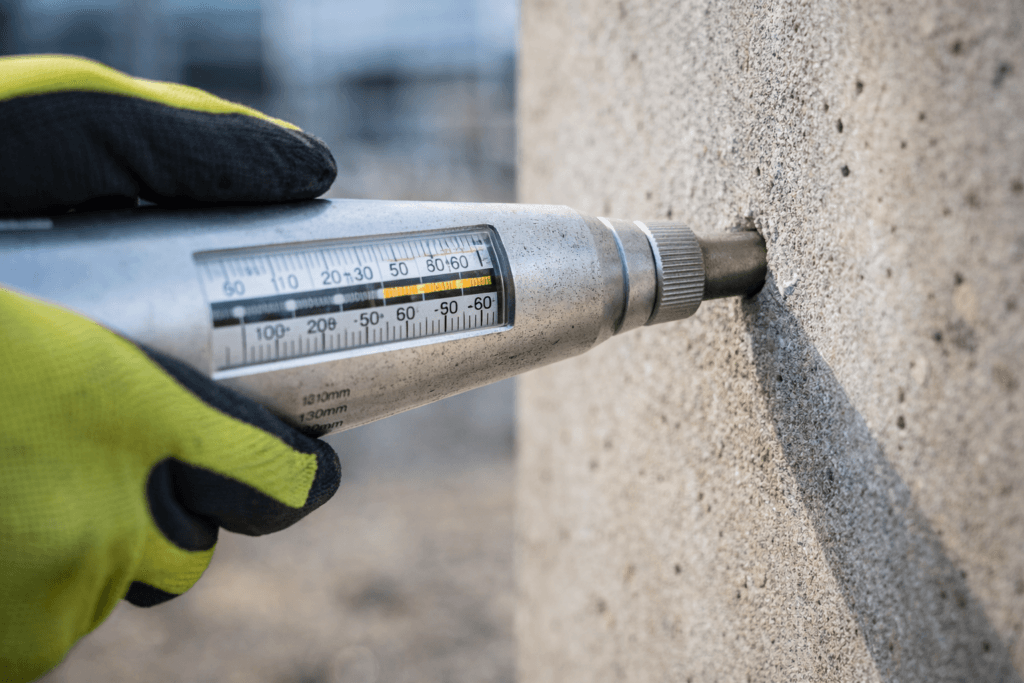
What Is the Rebound Hammer Test?
The Rebound Hammer Test, also known as the Schmidt Hammer Test, is a non-destructive testing (NDT) method used to estimate the compressive strength of concrete. Instead of drilling cores or crushing samples, this test measures surface hardness by recording how much a spring-loaded mass rebounds after striking the concrete surface.
The harder the concrete surface, the higher the rebound value—and generally, the stronger the concrete.
This method is widely used because it is:
- Fast and easy to perform
- Cost-effective
- Non-destructive
- Ideal for on-site testing
How the Rebound Hammer Test Works
The working principle behind the rebound hammer test is surprisingly straightforward.
- The hammer is pressed firmly against the concrete surface.
- A spring-controlled plunger strikes the concrete.
- The hammer rebounds after impact.
- The rebound distance is recorded as a rebound number on a scale.
This rebound number correlates with the surface hardness of the concrete, which can then be used to estimate compressive strength using calibration charts.
While it doesn’t replace laboratory testing, it provides a reliable preliminary assessment.
Types of Rebound Hammers
Different rebound hammers are designed for different testing needs:
- Type N Hammer – Most commonly used for normal concrete structures
- Type L Hammer – Used for lightweight concrete or smaller structural elements
- Type M Hammer – Suitable for mass concrete like dams
Choosing the correct hammer type is essential for accurate results.

Why the Rebound Hammer Test Is Important
In real-world construction and maintenance, engineers often need quick answers. The rebound hammer test helps by providing:
1. Rapid Strength Estimation
It gives immediate feedback on concrete quality without waiting for lab results.
2. Uniformity Assessment
By testing multiple locations, engineers can identify weak or inconsistent areas.
3. Structural Health Evaluation
It’s widely used during inspections of old buildings, bridges, and infrastructure.
4. Quality Control on Site
Helps confirm whether concrete curing and compaction were done properly.
Applications of the Rebound Hammer Test
The rebound hammer test is used across a wide range of construction and engineering projects:
- Residential and commercial buildings
- Bridges and flyovers
- Roads and pavements
- Industrial structures
- Dams and retaining walls
- Structural audits of aging infrastructure
It is especially useful in retrofitting projects, where engineers need to assess existing concrete before strengthening or modification.
Advantages of the Rebound Hammer Test
The popularity of this test comes from its many benefits:
- ✅ Non-destructive testing method
- ✅ Portable and easy to use
- ✅ Immediate results on site
- ✅ No need for sample extraction
- ✅ Cost-effective for large structures
Because of these advantages, it’s often the first step in concrete evaluation.
Limitations You Should Know
While useful, the rebound hammer test is not perfect. Its limitations include:
- Results depend on surface condition
- Moisture content can affect readings
- Carbonation of concrete may give higher values
- It estimates surface hardness, not core strength
- Requires calibration and experience
For critical projects, engineers often combine this test with Ultrasonic Pulse Velocity (UPV) or core testing for higher accuracy.
Factors Affecting Rebound Hammer Results
Several variables can influence test readings:
- Surface roughness
- Age of concrete
- Type of cement and aggregate
- Curing conditions
- Direction of testing (horizontal, vertical, overhead)
To minimize errors, tests should be performed on clean, smooth, and dry surfaces, following standard guidelines.
Rebound Hammer Test Procedure (Best Practices)
For reliable results, engineers follow a standard approach:
- Clean the concrete surface
- Avoid edges, cracks, or honeycombing
- Take multiple readings at one location
- Discard abnormal values
- Use average rebound numbers
- Refer to calibrated strength charts
Following these steps improves accuracy and consistency.
Rebound Hammer Test vs Core Test
| Feature | Rebound Hammer Test | Core Test |
|---|---|---|
| Type | Non-destructive | Destructive |
| Speed | Very fast | Time-consuming |
| Cost | Low | High |
| Accuracy | Moderate | High |
| Structural Damage | None | Minor damage |
In practice, the rebound hammer test is often used before deciding whether core testing is necessary.
Why the Rebound Hammer Test Still Matters Today
With growing emphasis on infrastructure safety, sustainability, and smart inspections, non-destructive testing methods are more important than ever. The rebound hammer test continues to be a trusted tool because it balances speed, simplicity, and practicality.
Whether it’s a new construction project or a decades-old bridge, this small handheld device helps engineers make informed decisions—quickly and safely.
Final Thoughts
The Rebound Hammer Test may look simple, but its impact on construction quality and safety is significant. By offering a fast, non-invasive way to evaluate concrete strength, it supports better planning, smarter maintenance, and safer structures.
In a world where infrastructure is constantly evolving, reliable testing methods like this remain essential—quietly ensuring that the concrete beneath our feet is strong enough to last.
Read More: The Future of Smart Speed Bump
Read More: High-Performance Concrete Build Business Case Value