
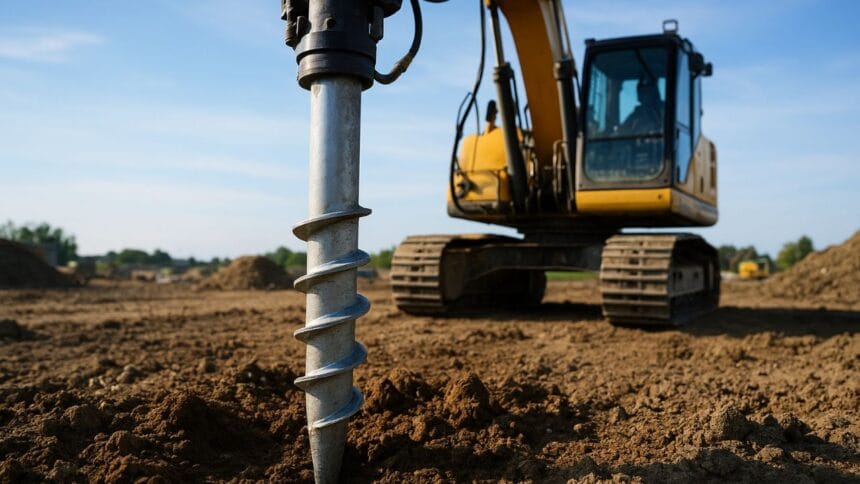
Ground Screws For decades, concrete foundations have been the default choice for construction projects whether it’s a house, deck, solar panel, fence, or commercial structure. But as construction methods evolve and sustainability becomes a priority, a quieter revolution is taking place beneath our feet. Ground screws are rapidly emerging as a modern, efficient, and Eco-friendly alternative to traditional concrete foundations.
From residential projects to large-scale infrastructure, ground screws are changing how we build. Faster installation, minimal environmental impact, and long-term durability make them one of the most talked-about foundation solutions in today’s construction world.
What Are Ground Screws?
Ground screws—also known as screw piles or helical ground anchors—are steel foundation elements that are screwed directly into the ground. Instead of digging, pouring concrete, and waiting for curing, ground screws are mechanically installed using specialized machinery.
Once installed, they act as a stable load-bearing foundation ready for immediate use.
They are commonly used for:
- Houses and modular buildings
- Decks and pergolas
- Solar panel systems
- Fencing and signage
- Temporary and permanent structures
- Infrastructure and commercial projects
Why Ground Screws Are Gaining Popularity Worldwide
Ground screws are not just a trend—they’re a response to modern construction challenges. Here’s why builders, architects, and engineers are embracing them:
1. No Concrete, No Waiting
Traditional foundations require days—or even weeks—of excavation, pouring, curing, and drying. Ground screws, on the other hand, are installed in hours and are immediately load-ready.
This saves time, labor, and project delays.
2. Environmentally Friendly Construction
Concrete production is responsible for a large percentage of global carbon emissions. Ground screws eliminate the need for concrete entirely, making them a low-carbon foundation solution.
They also:
- Produce minimal soil disturbance
- Generate less waste
- Preserve surrounding landscapes
3. Strong, Stable, and Long-Lasting
Made from galvanized or coated steel, ground screws are designed to withstand:
- Heavy loads
- Frost heave
- Seismic activity
- Harsh weather conditions
When installed correctly, ground screws can last 50 years or more.
How Ground Screws Work
The installation process is surprisingly simple but highly precise.
Step 1: Soil Analysis
Before installation, professionals assess the soil type, load requirements, and environmental conditions.
Step 2: Mechanical Installation
Using hydraulic or electric machinery, the ground screw is rotated into the soil—similar to screwing a bolt into wood.
Step 3: Precision Alignment
Laser-guided tools ensure the screw is installed perfectly vertical or angled as required.
Step 4: Immediate Load Bearing
Once installed, the structure can be mounted right away—no curing time needed.
This efficiency makes ground screws ideal for both permanent and temporary projects.
Applications of Ground Screws in Modern Construction
Ground screws are incredibly versatile and can be used in many construction scenarios.
Residential Construction
Homeowners use ground screws for:
- Garden sheds
- Decks and patios
- Tiny homes
- Modular houses
- Extensions and additions
Commercial & Industrial Projects
Businesses rely on ground screws for:
- Office cabins
- Signboards
- Canopies
- Warehouses
- Communication towers
Renewable Energy Projects
One of the fastest-growing uses is in solar energy installations. Ground screws provide strong foundations for solar panels without damaging the land—perfect for large solar farms.
Temporary Structures
Event stages, exhibitions, and temporary housing projects benefit from ground screws because they can be removed and reused.
Ground Screws vs Concrete Foundations
| Feature | Ground Screws | Concrete Foundations |
|---|---|---|
| Installation time | Hours | Days to weeks |
| Environmental impact | Low | High |
| Soil disturbance | Minimal | Significant |
| Weather dependency | Low | High |
| Load readiness | Immediate | Delayed |
| Reusability | Yes | No |
This comparison explains why many builders now see ground screws as the smarter alternative.
Performance in Different Soil Conditions
One common question is whether ground screws work in all soil types. The answer is yes—almost.
They perform well in:
- Clay
- Sand
- Gravel
- Mixed soil
- Frozen ground
In rocky or extremely hard soil, pre-drilling may be required. Proper soil testing ensures maximum safety and stability.
Cost Considerations: Are Ground Screws Expensive?
At first glance, ground screws may seem more expensive per unit than concrete. However, when you factor in:
- Reduced labor
- Faster installation
- No curing delays
- Lower equipment costs
- Minimal site preparation
The overall project cost is often lower.
Additionally, the long-term durability and low maintenance make ground screws a cost-effective investment.
Safety and Structural Reliability
Ground screws are engineered to meet strict building codes and safety standards. Load calculations ensure they can handle:
- Vertical loads
- Lateral forces
- Wind uplift
- Seismic stress
Many countries now include ground screw systems in their approved construction methods, making them a trusted choice for professionals.
The Role of Ground Screws in Sustainable Construction
As cities push toward greener development, ground screws play a crucial role in sustainable building practices.
They support:
- Eco-friendly construction
- Reduced carbon footprint
- Reversible building methods
- Minimal environmental disruption
This makes them ideal for projects in sensitive environments like forests, coastal areas, and heritage sites.
The Future of Foundations
With rapid urbanization and growing demand for faster, cleaner construction methods, ground screws are set to become a mainstream foundation solution.
Advancements in materials, automation, and precision installation will further increase their adoption across residential, commercial, and industrial sectors.
In the coming years, it’s likely that concrete foundations will no longer be the default choice—but one of many options.
Final Thoughts
Ground screws represent a smarter way to build from the ground up. They are fast, strong, eco-friendly, and versatile—everything modern construction demands.
Whether it’s a small backyard project or a large infrastructure development, ground screws offer a future-ready foundation that saves time, money, and the environment.
As the construction industry moves toward sustainability and efficiency, ground screws are no longer an alternative—they are the future.
Read More: The Future of Smart Speed Bump
Read More: High-Performance Concrete Build Business Case Value