
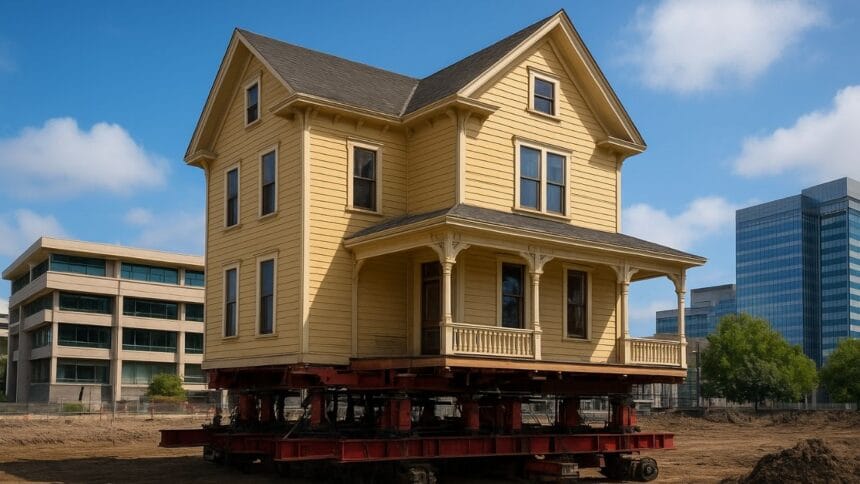
When we think about shifting a building from one place to another, the idea sounds almost impossible. After all, buildings are massive, heavy, and deeply rooted into the ground. But thanks to engineering innovations, building relocation has become a practical, sustainable, and cost-effective alternative to demolition. Around the world, cities are choosing to relocate entire structures—historic homes, temples, commercial facilities, even multi-story buildings—to preserve heritage, free up land, prevent damage from natural disasters, and support urban development.
This article breaks down how building relocation works, why it’s becoming more popular, and what benefits it offers to communities and developers.
What Is Building Relocation?
Building relocation—also known as structure lifting and shifting—is the engineering process of moving a complete building from its existing location to a new one without breaking it down. This can involve moving a structure horizontally across the ground or vertically raising it to protect it from floods or foundation issues.
There are two major types:
1. Structure Lifting
The building is lifted vertically using hydraulic jacks. This method is used when:
- Foundation needs repair
- Flood protection is required
- Basement construction is planned
- The ground level needs to be raised
2. Structure Shifting
The building is placed on rollers, rails, or hydraulic dollies and moved horizontally. This is used when:
- Roads or highways need widening
- Heritage structures need preservation
- Land is required for new infrastructure
- Buildings sit in unsafe zones
This technique allows a structure to remain intact and usable even after the move.
Why Building Relocation Is Becoming Popular
Around the world, especially in fast-growing cities, building relocation is being seen as a smart, sustainable solution. Here’s why:
✔ 1. Protecting Heritage Structures
Many old temples, historic homes, and culturally important buildings face the threat of demolition due to urban expansion. Relocation allows them to be preserved without hindering development.
✔ 2. Avoiding Demolition Costs
Demolishing a building can be extremely expensive. Not only do you pay for demolition, but also debris disposal, land cleaning, and reconstruction. Relocation often costs less and saves resources.
✔ 3. Reducing Environmental Impact
Demolition creates massive waste. Relocating a building prevents tons of debris from entering landfills, making it a more eco-friendly option.
✔ 4. Adapting to Urban Growth
Cities worldwide are widening highways, building metro lines, constructing commercial towers, and redeveloping congested neighborhoods. Relocation frees space without destroying usable buildings.
✔ 5. Protecting Buildings in Disaster-Prone Areas
Raising buildings protects them from:
- Flooding
- Soil erosion
- Foundation sinking
- Coastal tides
This is especially common in flood-prone regions.
How Building Relocation Works: Step-By-Step
Modern building relocation is a highly organized engineering process. Here’s how experts do it:
Step 1: Structural Assessment
Engineers inspect:
- The building’s strength
- Foundation conditions
- Material type (brick, concrete, wood, etc.)
- Weight distribution
- Possible risks
This helps decide the safest relocation method.
Step 2: Planning the Relocation Route
If the building must shift horizontally, engineers plan:
- Road space
- Obstacles like poles or trees
- Traffic management
- Leveling of the path
For vertical lifting, they plan hydraulic support systems.
Step 3: Strengthening the Structure
Steel beams are inserted to support the building and prevent cracks during movement.
Step 4: Lifting the Building
Hydraulic jacks raise the structure in small increments. Sensors ensure even lifting to avoid structural imbalance.
Step 5: Moving the Structure
Depending on distance and terrain, the building is shifted using:
- Roller beams
- Hydraulic dollies
- Rail tracks
- Skid systems
For long-distance relocation, heavy transport vehicles may be used.
Step 6: Positioning & Foundation Work
A new foundation is prepared at the destination. The building is lowered slowly and secured.
Step 7: Final Inspection
Engineers perform:
- Crack checks
- Level alignment
- Foundation stability tests
Once everything is safe, the building is officially handed over.
Real-World Examples of Building Relocation
Building relocation is not futuristic—it’s already happening globally.
✔ China’s “Walking Building”
Shanghai engineers used robotic legs to literally “walk” a school building 60 meters away to make room for redevelopment.
✔ United States: Historic Home Moves
Thousands of wooden homes and heritage buildings have been shifted across cities to preserve history.
✔ India: Temple Relocation
Many temples and old houses in flood-prone and highway-expansion zones have been lifted or moved using hydraulic systems.
These examples prove how powerful modern engineering has become.
Benefits of Building Relocation for Cities & Homeowners
1. Saves Time
Constructing a new building takes months or years. Relocation takes days or weeks.
2. Saves Money
Relocation is often 40–60% more cost-effective than demolition + reconstruction.
3. Helps Urban Planning
Governments can develop smart roads, metros, bridges, and commercial zones without destroying important buildings.
4. Prevents Loss of History
Relocation keeps cultural and architectural heritage alive.
5. Adds Value to Property
A raised or relocated building becomes safer and often increases in market value.
Challenges & Risks in Building Relocation
While the technique is advanced, it’s not without challenges:
- Requires highly skilled engineers
- Incorrect balancing can cause cracks
- Weather can delay work
- Old buildings may need reinforcement
- Cost varies based on weight and distance
Selecting an experienced relocation company is crucial.
Future of Building Relocation
As cities evolve and land becomes scarce, relocation will become even more important. With AI, robotics, and automation entering the field, the next decade may bring:
- Self-balancing robotic movers
- Faster hydraulic systems
- Routes planned using smart mapping
- Reduced relocation costs
Soon, relocating a building may become as routine as shifting heavy machinery.
Final Thoughts
Building relocation is more than an engineering miracle—it’s a smart investment in sustainability, heritage preservation, and urban development. Instead of demolishing valuable structures, modern technology gives us the power to move them safely and efficiently.
As the world shifts toward greener and smarter cities, relocation is set to become one of the most important tools in the future of construction and urban planning.
Read More: The Future of Smart Speed Bump
Read More: High-Performance Concrete Build Business Case Value